
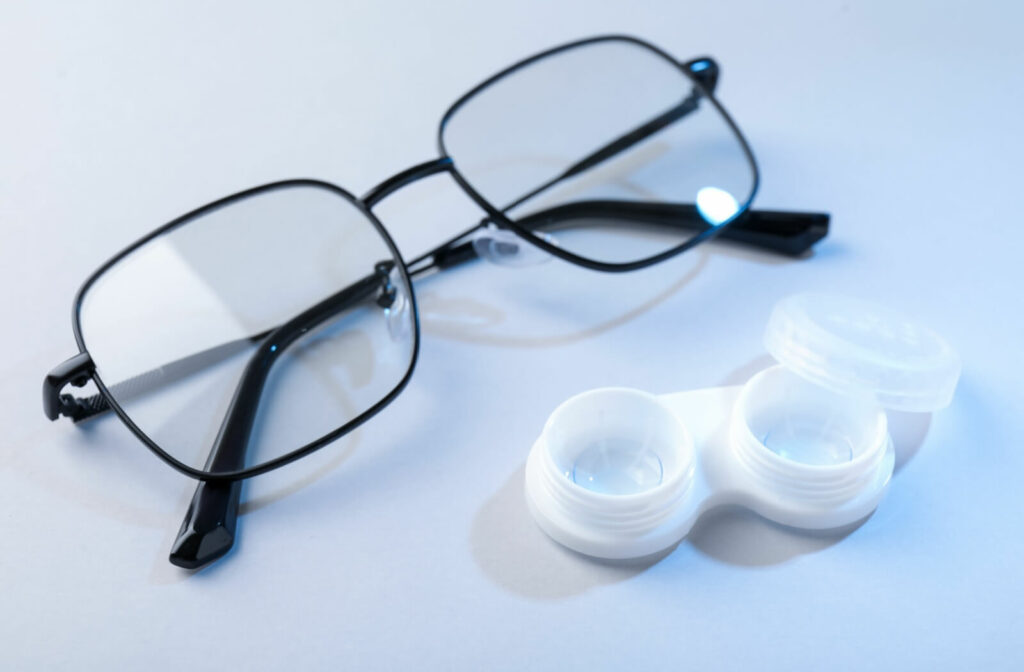
At Total Focus Optometry, our team is often asked if a prescription for glasses can be used to order contact lenses. Though we understand the convenience of this, it’s important to understand what makes the 2 prescriptions different.
Your contact lens and glasses prescriptions are not the same and cannot be used interchangeably. Each has specific measurements based on where the lens sits, and using the wrong one can affect your vision and eye health, which is why a contact lens exam is so important.
Why Your Prescriptions Are So Different
How Glasses Prescriptions Work
Your glasses sit around 12–14 millimetres away from your eye itself. When you get a prescription for glasses, an eye doctor calculates your prescription to focus light from that specific distance. Your glasses prescription usually also includes a measurement called the pupillary distance (PD), which is the space between your pupils. This number helps make sure you’re seeing out of the centre of the lenses so that you see clearly.
How Contact Lens Prescriptions Work
Contact lenses are different because they sit directly on the surface of your eye. This can change the calculation for your prescription strength, especially for stronger prescriptions. A contact lens prescription also needs extra details about your eye’s unique shape and size to help them sit comfortably. It can even specify the exact brand and material, as different types of lenses fit and feel differently.
Key Information on Each Prescription
What Your Glasses Prescription Shows
Your glasses prescription is tailored for the frames you’ll be looking through. This means all measurements are calculated assuming the lenses are a specific distance from your eyes. It contains a few key pieces of information to give you clear vision:
- Sphere, cylinder, and axis values that correct your specific vision issue.
- Prism correction if your eyes need help to work together as a team.
- Your pupillary distance measurement for precise lens alignment.
What a Contact Lens Prescription Adds
A contact lens prescription provides more detail about the fit of the lens itself. Getting these details right is key to keeping you comfortable and healthy while you wear your contacts. Because it makes direct contact with your eye, the prescription must include additional measurements to prevent potential discomfort:
- The base curve (BC) to match the curvature of your eye’s surface.
- The diameter (DIA) to make sure the lens is the right width.
- The specific brand and type of lens that is suitable for you.
The Difference in Prescription Power
Why the Numbers Often Change
The distance between a lens and your eye has a big impact on its power. Because glasses sit further away, the power listed on the prescription is different from what you would need in a contact lens that rests on your eye. For stronger prescriptions, this difference becomes even more significant.
Can You Use a Conversion Chart?
You might find charts online that claim to convert a glasses prescription to one for contacts. These charts are not typically accurate because they are only estimates. They don’t account for your individual eye shape, health, or the specific type of contact lens that is right for you.

The Need for a Contact Lens Fitting
What Happens During a Fitting
A contact lens fitting is often a separate appointment from a regular eye exam. During the fitting, our team measures the surface of your eye to find its shape and size. The eye doctor can also check for any conditions, like dry eye, that could affect how you wear contacts. You’ll often receive trial lenses to test at home to see how they feel and perform before you commit.
Risks of an Improper Fit
Wearing a contact lens that doesn’t fit correctly, along with other common lens mistakes, can lead to problems that go beyond poor vision. Your eyes need to breathe, and the right fit helps oxygen to reach the cornea (the clear outer layer of the eye), which is important for long-term health. A lens that is too tight, too loose, or made from the wrong material can cause a range of issues:
- Discomfort, redness, and eye irritation.
- Blurry or unstable vision that shifts as you blink.
- An increased risk of developing eye health issues.
Get the Right Prescription for Your Vision
Schedule a Comprehensive Eye Exam
A great first step toward clear vision is a routine eye exam. You can get an updated prescription for your glasses and a thorough check of your overall eye health.
Book a Separate Contact Lens Evaluation
If you want to wear contact lenses, let our team know so you can schedule a contact lens evaluation and fitting. This dedicated appointment helps find the lens that fits your eyes comfortably and gives you great vision. An eye doctor in South Edmonton can walk you through the process and teach you about proper lens care, including inserting, removing, and cleaning your new lenses safely.
Get Your Contact Lens Prescription
Your vision is important, and having the correct prescription for both your glasses and contact lenses makes all the difference. For personalized attention and care for all of your eye care needs, the team at Total Focus Optometry is ready to help. Schedule your appointment today.